
Do we really know what „sustainability“, „artificial intelligence“ or „mobility solutions“ stand for? Do we have the same understanding what stands behind these words? In the 1990s the German linguistic scientist Uwe Pörksen framed the “plastic words” phenomenon – words that are characterized by abstract meaning, marketing talk and no concrete mental image. Unfortunately, we often find these words in future communication. How to deal with it?
What are plastic words?
Plastic words are used in everyday language, but also in academia. They are vague so that everyone can use them without stating anything precise. Particularly in discussions between participants with very differing views, they offer opportunities for agreement due to the characteristics outlined above. Since they do not express a precise idea, almost anyone can agree, even if the underlying concepts of the opposing parties are worlds apart.
For the same reason, it is extremely difficult to argue against them. Plastic words usually originate from the scientific community, where they represent rather technical terms. They have gradually found their way into everyday language and are now relatively popular, as they surround the speaker with an air of expertise and grant them interpretative authority. Plastic words are vague, highly abstract terms that sound authoritative and scientific, but have been stripped of specific, objective meaning.
German linguist Uwe Pörksen describes it as follows:
„The transformation of the vernacular can be grasped by studying a small group of words and a way of using them that is characteristic of the last few decades. I call them plastic words. Linguists might call them connotative stereotypes. The everyday use of the word “communication” is an example.“
Want some more examples? „information society“, „information“, „sustainability“ „substance“, „value“, „growth“, „welfare“, or „development“.
The use of plastic words in futures context: Trends that say nothing and everything
Lately, plastic words are often used when we talk about mega trends like „security“, „urbanization“, „future of work“, „demographic change“, „knowledge culture“, „identity dynamics“, „eco intelligence“, „mobility“, „connectivity“, or „globalization“. These words have also a scientific meaning but can be interpreted in very diverse ways. Everyone has an understanding about their meaning, but this might be dramatically different, positive or negative.
Of course, mega trends are an attempt to structure the somewhat complex nature of trends and signals. The core idea is to give guidance when it comes to grand future challenges. However, looking at scenario projects or future-oriented communication of enterprises and politics one thing becomes obvious. If you are too ambiguous about how you frame and describe the future, you will be one out of many – and not the one that makes a communicative and competitive difference. Its all about clarity.
Be more precise in what you really want to achieve in the future
If you want to avoid using „plastic words“ – or in a way „plastic trends“ – then you should focus on a competitive story about the future that showcases your particular path towards the future.
If you want to avoid using „plastic words“ – or in a way „plastic trends“ – then you should focus on a competitive story about the future that showcases your particular path towards the future.
This means, you should look at trends and find specific answers how you will react to trends. Specifically, do not focus on a „plastic word“ alone like „security“ or „substainability“ but tell your own story using your own vocabulary and trends and narrative features. Be clear how you make a difference in the future.
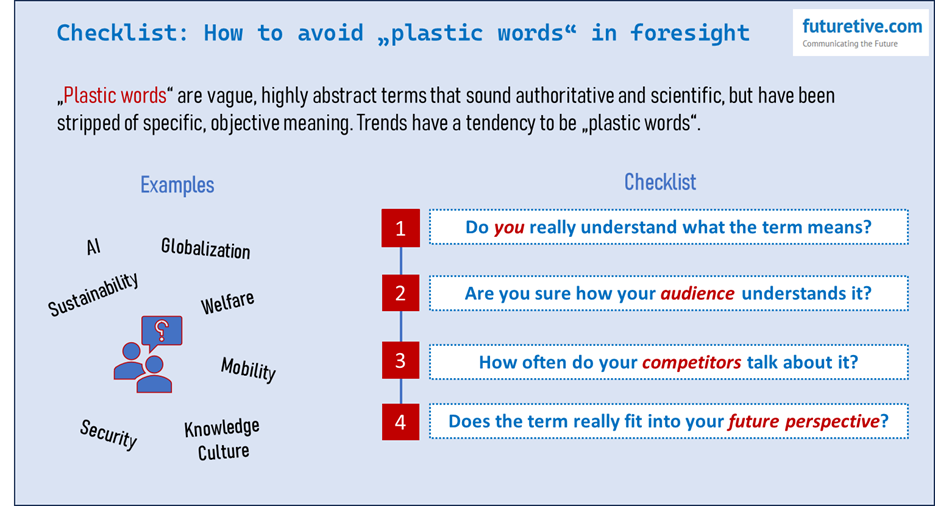
It is not about preaching future technical specifities to the public or your customers. It is rather translating technical and scientific solutions into a grand picture and a story that fits your organization – ideally without using plastic words.
And if you really cannot work without plastic words in your communication, make sure you explain in depth what really connects you with it, why it is of utmost importance for your organization and whats your precise future plan about it. Clarity is king.