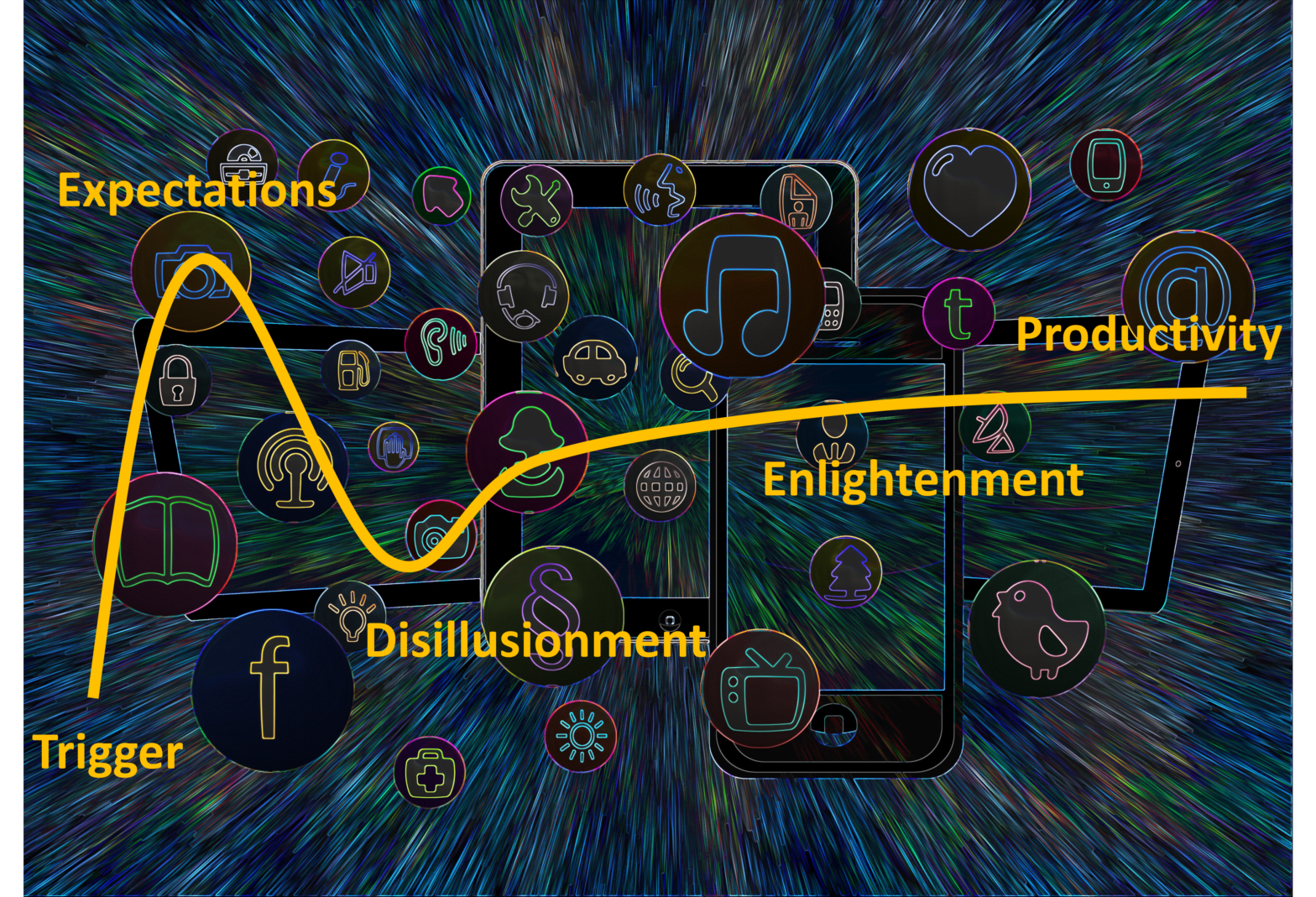
No one really knows how future developments will turn out in the end. But we often see technology hypes, where promises drift apart from realistic expectations. This creates several communication challenges: how to cope with hypes, and how to get strategic messages and core narratives about the future across. Hype Cycle Communication strategies can help in getting getting core messages through the hype cycle
Artificial intelligence, social media, democratic crisis, and e-mobility: many technological and societal developments attract far more attention than average. Yet not all survive the hype phase. Some are overtaken by others; some must pass through a consolidation phase and change their core meaning; others fall silent for a while and then wake up again, even more convincing and productive. Everyone engaged in communication must recognize hypes and develop strong strategies to deal with them.
What are hypes? And what are hype studies?
Hypes are social phenomena often understood as media-generated waves. In the age of social media, a hype can grow and fall extremely fast. These waves differ from other major stories because they seem to develop “a life of their own.” Coverage becomes increasingly driven by prior coverage rather than by independent events. This creates a mismatch between media attention and the frequency or importance of actual occurrences, making the news wave self-referential and producing the impression that a problem is spreading or worsening. Interestingly, media and social media do not merely report events; they actively participate in constructing the social problems, scandals, or crises they cover.
According to Vestermann, a hype can develop in five phases:
- Positive feedback loops cause news stories to gain momentum because their presence in the media makes them seem more newsworthy.
- A key event triggers the wave. This key event may be a serious incident, but it may also be an ordinary event that becomes extraordinary through framing, public statements, investigative reporting, or timing. Key events may come from stakeholders such as politicians, activists, or economic actors.
- A news theme emerges, turning a particular incident into an example of a broader social problem.
- News thresholds temporarily fall: reports, statements, and similar incidents that fit the dominant frame receive attention, while contradictory or unrelated information is marginalized.
- Interactive momentum arises as social actors — politicians, institutions, interest groups, citizens, victims’ relatives, or protest movements — react to the coverage, thereby generating further news.
The link to future messages
For future-oriented communication, especially around promising technologies, hype can be both productive and destructive. It differs from broader future concepts such as “vision,” “imaginary,” or “expectation” through its intense focus on time and attention. A special issue of the Journal for Technology Assessment in Theory and Practice stresses that calling something a hype is both descriptive and action-guiding: it invites criticism of exaggerated promises and warns of poor public decisions, misdirected investment, neglected societal consequences, and damage to scientific trust.
Several features are central to technology hypes. First, they rely strongly on rhetoric and emotional appeal:
- bold statements,
- superlatives,
- breakthrough metaphors,
- historical analogies,
- fictional references, and
- promises of disruption.
Such language can mobilize audiences, but it can also bypass rational assessment. Social media platforms amplify this dynamic through likes, shares, hashtags, algorithmic visibility, sensationalism, and clickbait.
The authors describe hype as deeply temporal. It highlights immediate opportunities and urges actors to act quickly, narrowing attention to short-lived peaks and outliers rather than long-term societal consequences. It also involves strategic impression management. Actors use buzzwords — so-called “plastic words” — such as “AI,” “nano,” “smart,” or “green” to attract attention, funding, legitimacy, or market value. Scientists, companies, policymakers, journalists, investors, and communities of practice may knowingly repeat future promises even when they privately doubt them.
Hypes are therefore phenomena that must be studied in terms of strategic communication. They connect to long-term strategic messages, sound and sustained future narratives, and competitive advantage in the attention economy. To ride a hype wave with the right Hype Cycle communication strategy, communicators and foresighters must understand what a hype is, where a trend or technology stands, and how to respond accordingly in their communication.
Understanding the Gartner Hype Cycle for Communication
Gartner analyst Jackie Fenn introduced the Gartner Hype Cycle in 1995. Gartner analysts first used the concept internally to track emerging technologies before it gained broader traction. The methodology expanded into an annual flagship report series, such as the Hype Cycle for Emerging Technologies, which tracks and evaluates trends like early Wi-Fi, VoIP, blockchain, and generative AI.
The five phases are:
- Innovation Trigger: A technological breakthrough or product launch attracts initial attention, and there is often no market-proven evidence of economic benefit yet.
- Peak of Inflated Expectations: Initial successes generate media hype and great enthusiasm, but they also lead to many failed pilot projects.
- Trough of Disillusionment: Interest wanes because the technology has failed to meet unrealistic expectations, and the first providers disappear from the market.
- Slope of Enlightenment: Companies gradually understand the true benefits, and mature second- and third-generation products emerge.
- Plateau of Productivity: The technology becomes mature, gains mainstream adoption, and delivers stable business value.
Critics and analysts have also raised concerns. Decades of use show that while the framework effectively captures popular perceptions and media buzz, technologies do not always strictly follow the deterministic curve. One major criticism is that the model builds on a single wave of hype. In reality, expectations move iteratively among different stakeholders (pp. 17–21) — governments, industry, media, and ethics bodies — going back and forth with positive and negative implications for a technology or trending topic. Actors recalibrate expectations when developments go in the wrong direction or when audiences react or misinterpret them. The hype cycle remains a well-known tool for understanding hypes, but it has shortcomings in capturing their real dynamics. Communication strategy must take this into account.
Implications for communication
When we examine the five phases of the originally designed hype cycle, we can see how communication should be planned in each phase. The following picture assumes that your organization remains fully convinced of a topic or technology throughout the entire hype cycle. Thus, your organization uses strategic communication, targeted messages, and materials to support its position in each phase. For each phase, you must choose how to adjust your narratives in the Hype Cycle Communication.
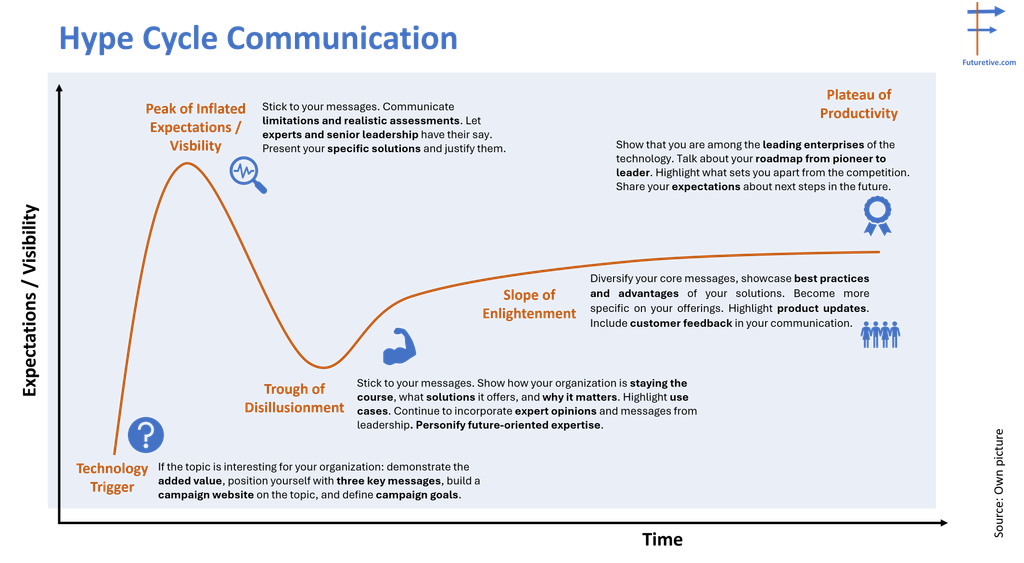
Roberson and colleagues (2023) identify further implications for strategic communication and for managing issues and trends during a hype or media wave. These recommendations respond to the criticism of a single-cycle model:
- Communicators must manage hype as a permanent feedback loop, not as a one-off campaign trajectory. Those who create expectations must reckon with the fact that these expectations will return to them in transformed guise. Promises are not one-way communication; they are commitments to later, unknown audiences.
- Strategic rhetoric produces path dependencies and counter-narratives. Selling a trend simultaneously means dissecting the issues the trend later throws back — ethics, security, energy footprint, and “impossible promises.”
- “Kairos” and timing are core strategic resources. In high phases, organizations must emphasize the “right time” and frame risks encouragingly. In low or trough phases, they must allow uncertainty, pessimism, and recalibration. Both belong to the same strategic practice: “low expectations” are not the opposite of hype, but a phase of hype management.
- Lowering expectations is itself a communication strategy. Strategic communication must distinguish front-stage and backstage narratives and must not ignore the gap between product promises and internal insights. Otherwise, journalists, activists, and competitors may expose the gap externally.
- Trend and issue communication must anticipate audience shifts. Those who communicate trends along a hype curve must forecast not only the degree of attention, but also how the issue itself changes in meaning.
In short, communicators must understand the phases of a hype, how hypes emerge, and how to use every stage for a competitive communication advantage. As the number of hypes seems to increase, future communication must utilize hypes and deal with them strategically from the very beginning. Do so proactively rather than being pushed by hypes.
Recommended further reading on the issue: hypestudies.org
Hypestudies.org is an international collective of researchers, designers and practitioners who are concerned, yet interested by the phenomenon of hype across science and technology. Initially gathered at the first hype studies panel at European Association for the Study of Science and Technology (EASST) conference, members decided to share questions and mobilise a community of people with similar interests.